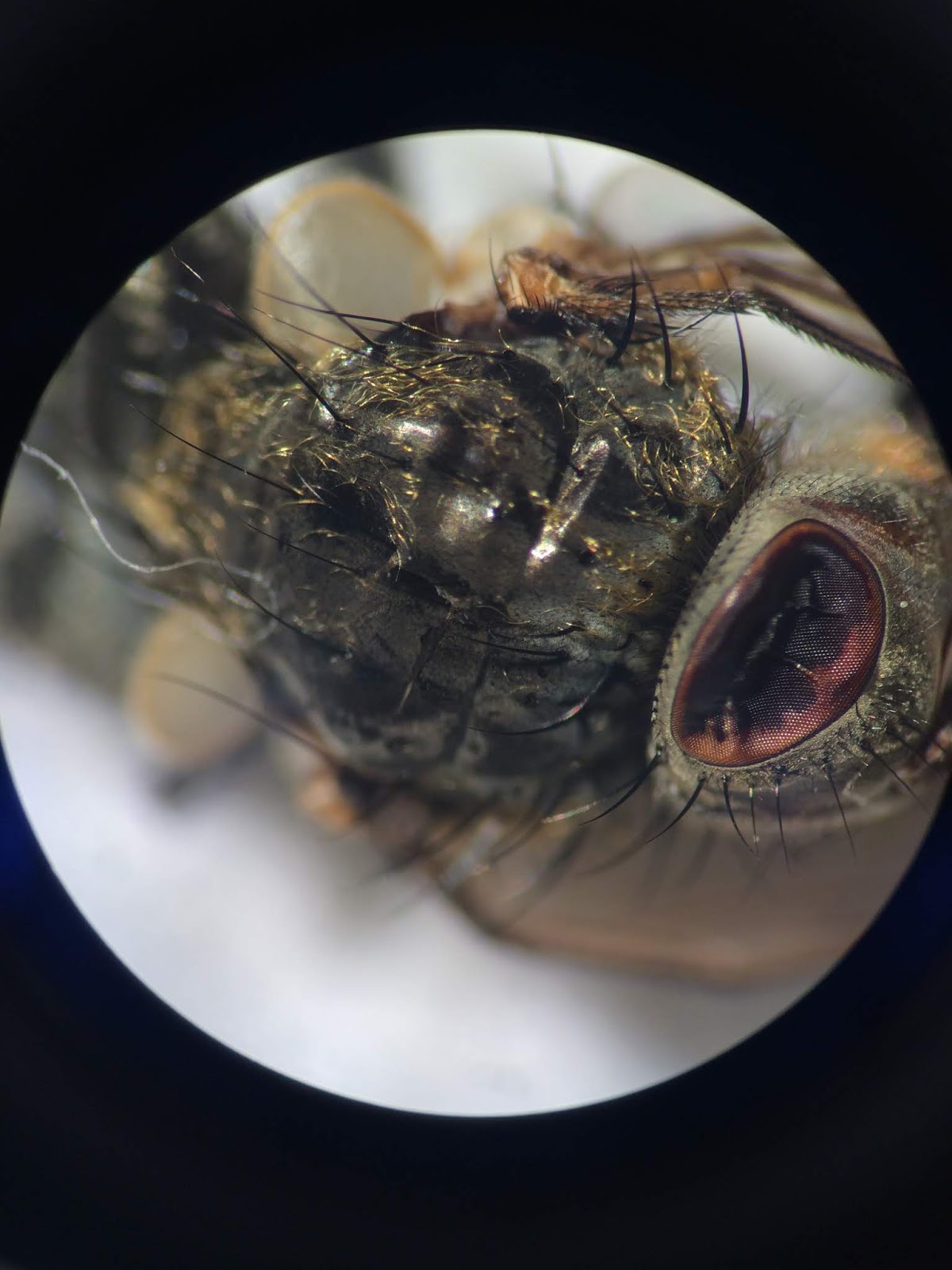
I was initially interested in the summer impact project “Ecology meets Forensic Entomology” because a staff member I work with during the school year on a native grasses and bee research project suggested I apply. Given my general interest in entomology and succession community dynamics, I felt the project would give me great research experience and improve my ability to identify, organize, and analyze entomology samples. Although I did not have direct interest in forensic science, medical entomology and public health have always been of interest to me, and this summer seemed like an opportunity to widen my horizons in interdisciplinary work. The skills I would learn this summer about how to conduct research will be important as I begin graduate school after graduating this Fall 2019. I would also like to continue working on projects involving invertebrates and their conservation and applications in ecology in the future, and this project gave me great experience with identification and general knowledge of forensically significant taxa such as Calliphoridae, Sarcophagidae, Muscidae and Fannidae flies and Staphylyndae and Silphidae beetles.
During the first 2 weeks of the OSCAR summer impact program we spent almost all of our time in the field at the Clifton Institute, placing 48 carcasses under emergence tents to collect samples. We returned daily to check on the samples, record observations and collect samples to be stored in ethanol and brought back to the lab. Once the initial collection was completed, we spent our following weeks in the lab working together to identify the forensically significant members of the samples, pinning specimen for collections, and discussing our hypothesis.
During this experience I discovered my strengths and weaknesses regarding research and made a plan for this coming semester to improve certain research skills during my internship such as grant application, budgeting grant money, writing proposals, and general science communication skills. By setting these objectives, I will improve my chances of being successful in graduate school and beyond.
Thursday, December 19, 2019
Wednesday, December 18, 2019
URSP Student Sam Yee Investigates 2-Dimensional Materials for Photonic Utilization
I first became interested in the study
of 2-Dimensional(2D) materials when I began investigating undergraduate research opportunities within the Physics Department at GMU. 2D materials have tremendous potential to
change the landscape of technology as the maximum efficiency and overall sized
of electronics are largely determined by the individual components inside them.
During my time in the Vora Lab I have
learned many valuable skills in 2D material handling and sample preparation. I have learned and practiced methods of optical
experiment design, assembly, alignment and calibration. I have also fine-tuned
techniques of sample data collection and analysis. Finally, I have been immersed in the field of
2D materials research as I review other researcher’s publications, prepare
reports on my own experiments, and write proposals for funding, which are all
invaluable skills within the field of optics.
For a normal week I prepare 2D samples for measurement and then take various images
and spectral measurements of those samples.
I setup, align and calibrate optical equipment that is used in gathering
those data. I process and analyze the
data that I have collected as well as prepare summaries for my mentors and the
other research teams we corroborate with.
I also review several current research papers that my professor
highlights from my field. I converse
with my graduate student mentors several times a day as well as my professor
mentor about once a day. I sit in on
conference calls or meetings with other research groups, both at GMU as well as
other universities regarding various topics currently under investigation in
our lab. Finally, I review and answer
emails from these other groups regarding our research.
I am
honored and grateful for the opportunity provided by the URSP to conduct
research in the field of optics and 2D materials. I am also very grateful my mentors, Dr.
Patrick Vora, and graduate students, Sean Oliver and Jaydeep Joshi who provided
invaluable advice and guidance throughout the duration of this study.
Tuesday, December 17, 2019
STIP Student Kara Wright Explores Forensic Nursing with Image Analysis and Data Management
The opportunity to conduct research and complete data analysis sparked my interest in participating in the Summer Team Impact project. This was also a great way to learn more about job responsibilities forensic clinicians, which requires a great degree of compassionate care towards patients. Everything that I have learned about research and forensic nursing this summer has greatly impacted my long-term career goals. I now feel like I have an understanding of the steps required to conduct a research study, as well as the many different roles forensic nurses have their patient’s plan of care.
On a weekly basis, my research partner and I complete data analysis on our supervisor’s previous research study. This entails cleaning up bruise image files, renaming images, and verifying image information across data collection platforms. We have also been conducting our own research study since mid-way through the summer and have been seeing participants and collecting data for our poster project.
I discovered how interconnected different disciplines of study are in real-world situations. Nurses often rely on health informatics staff to help streamline their workflow on computer software while engineers look to nursing staff to understand physiological occurrences when analyzing how machines learn from human subject images.
On a weekly basis, my research partner and I complete data analysis on our supervisor’s previous research study. This entails cleaning up bruise image files, renaming images, and verifying image information across data collection platforms. We have also been conducting our own research study since mid-way through the summer and have been seeing participants and collecting data for our poster project.
I discovered how interconnected different disciplines of study are in real-world situations. Nurses often rely on health informatics staff to help streamline their workflow on computer software while engineers look to nursing staff to understand physiological occurrences when analyzing how machines learn from human subject images.
Monday, December 16, 2019
STIP Student Jeremy Williams Investigates the Complexities and Dynamics of Aquatic Life
Life in the aquatic environment has always had my interest since I was young. It’s just something about life under water that fascinates me. My OSCAR research project this summer has been a phenomenal experience so far. Learning about fish communities and assemblages has shown me a different perspective of life. I never really knew how dynamic and complex a fish’s life could be until I came here. Now, I have developed appreciation, care, and respect for all fishes. In addition to studying about fishes, I also learned how to identify fish on the adult, juvenile, and larval level. I believe that identifying fish can be rewarding because it can get difficult trying find the intricate details to identify each fish at different stages of their lives. Also, being able to go out on the boat every week and seeing the natural scenery of both sample sites is something that the “Average Joe” doesn’t get to see every day.
Being around other people that are passionate about science and love it as I do makes me feel at home. Coming to work and being able to sit in the lab to doing science every day is feeling that I cannot explain. I love every second of arriving to the Potomac Science Center and looking out the window to see that awesome view of the Potomac River. Furthermore, the people in the building are all friendly and are willing to help anyway they can. This might seem small but having key card access to your lab is so awesome! It makes you feel like you are entering in a TOP SECRET room, but it’s just your lab.
All this fun and excitement comes with hard work as well. I have taken pride in my research and study and cannot wait to present my project findings at the poster presentation to show what I’ve been working on this entire summer. If I could give advice to future student researchers, it would be to apply to not only just OSCAR internships but to any internship. I guarantee that it will be an experience you will never forget. Our first week at PSC, Ben and I dissected a Remora AKA “Shark Sucker” in Dr. de Mutsert’s fish lab. In the mist of all this happiness and joy, the entire room smells like fish!
Sunday, December 15, 2019
STIP Student Taylor Day Performs Fitness Tests on Policemen and Firefighters
My name is Taylor Day and I am a senior at George Mason University, majoring in Athletic training. One day, one of my professors in my program came in
and spoke about an opportunity to do research this summer on police and
firefighters in Prince William County. To this day, that’s all I remembered before I knew I would apply.
Eventually, I learned that I would be doing research working with a team in order to conduct a descriptive, cross-sectional analysis of health-related quality
of life (QoL), movement capabilities and fitness levels of police and firefighters in Prince William county. This opportunity, I felt was huge and paralleled right into my field of study and my future career goals. Additionally, I
knew that this was a unique and interesting population to work with, knowing that there was
little information and previous knowledge on firefighters and police.
In this program, we meet once a week as a whole to discuss protocols, duties, weekly assignments, and
scheduling. Throughout the week, we fitness test police and firefighters by appointment and
then work on fitness reports and exercises programs catering to the police and firefighters
needs and goals physically. The fitness report is a form that exemplifies the subject’s movement capabilities, scores them on the fitness test, and gives recommendations on what should be the focus based on
their performance during testing. The exercise program is a six-week program focusing on six weeks of strength exercises, corrective exercises, and six weeks of conditioning.
This project really taught me a lot and
really broadened my horizon on health and fitness
promotion as a whole. Furthermore, it provided me opportunities to learn new things outside of my realm of
athletic training and practice skills outside of the classroom. My research definitely
has an impact on not only me but the community.
Subscribe to:
Posts (Atom)