Tuesday, December 10, 2019

STIP Student Sierra Strickler Researches the Impact of Sexual Assault

I was inspired to do this research project primarily because of the events surrounding Brett Kavanaugh and the #MeToo movement, as well as by the sexual harassment and violence that all women are familiar with in some way. Throughout my life, I have seen people I know to be affected by sexual assault; one particular friend of mine even had to drop out of college to escape her two attackers, was brave enough to take them to court, and then lost her case as well as all of her money. This friend, as well as too many other friends, strangers, and stories, all motivated me to be outspoken about the issues related to sexual assault and to join the Peer Advocate Program at George Mason's Student Support and Advocacy Center. There I have had the honor to work to promote positive change surrounding sexual assault, such as providing safe spaces for survivors to come forward and providing education about safe sex and consent to our students. When I saw the beginnings of the #MeToo movement, I was in awe of the bravery of the people who came forward to share their stories. Unfortunately, many were met with backlash and hatred, even from women. I couldn’t understand how any woman (or any person, really) could be against people speaking out against assault or be indifferent, even supportive of people who commit sexual assault.

This research also fits into my personal goals, as I want to delve deeper into research, go to graduate school, and earn a doctorate in psychology. I’m not sure what I want to focus on in the future, but this project has been incredibly interesting and gratifying. I’ve learned a lot from this research that I can apply to whatever I end up doing.

So far, most of my time has been spent doing literature reviews for various purposes: background knowledge, reasoning to help form hypotheses, and to find pre-existing measures to use. During this term, I discovered how difficult it can be to find certain literature even though you know that it’s out there. Experimenting with different keywords and search features is vital!

Monday, December 9, 2019

STIP Student Marie Tessier uses Immunohistochemistry to Measure Protein Expression for Conserving Genetics in Endangered Animals

I am a Biology major looking to veterinary medicine as my future career path. Many vet schools require research experience, so I jumped at the opportunity for a summer project with OSCAR. I found a mentor from the Smithsonian Conservation Biology Institute (SCBI) in Front Royal, where the National Zoo breeds endangered animals and performs research for conservation. My project is about in-vitro spermatogenesis, the production of sperm in a lab dish from testicular tissue. This could be very useful for endangered animals which die before reaching maturity or have fertility issues because it would allow them to still contribute their genetics to the population. However, in-vitro spermatogenesis has only been successful in mice and rats, so researchers at SC Blare working to produce sperm in the lab from lambs, as a model for endangered ungulate species. 

My main task was to measure protein expression using a staining technique called immunohistochemistry. This two-day procedure involved taking microscope slides with the tissue samples and soaking them in a number of treatment solution search timed for specific durations. After staining was complete on day 2, I looked at the slides under a light microscope to analyze the staining pattern. To obtain the sample slides, I had to section paraffin wax blocks containing the tissue pieces using a microtome. I was busy in the lab, but I had time to read scientific articles during waiting periods so I could learn more about my topic. 

One thing I discovered about research is that no matter what goes right or wrong in an experiment, there is always something to learn. One of my antibodies failed to work at all. However, my mentor used that opportunity to teach me about troubleshooting immunohistochemistry protocols. When I obtained positive results, I was able to understand the role of the protein in the cell and in spermatogenesis. Though my research part was small, I contributed to a much bigger picture for endangered animal conservation.

Sunday, December 8, 2019

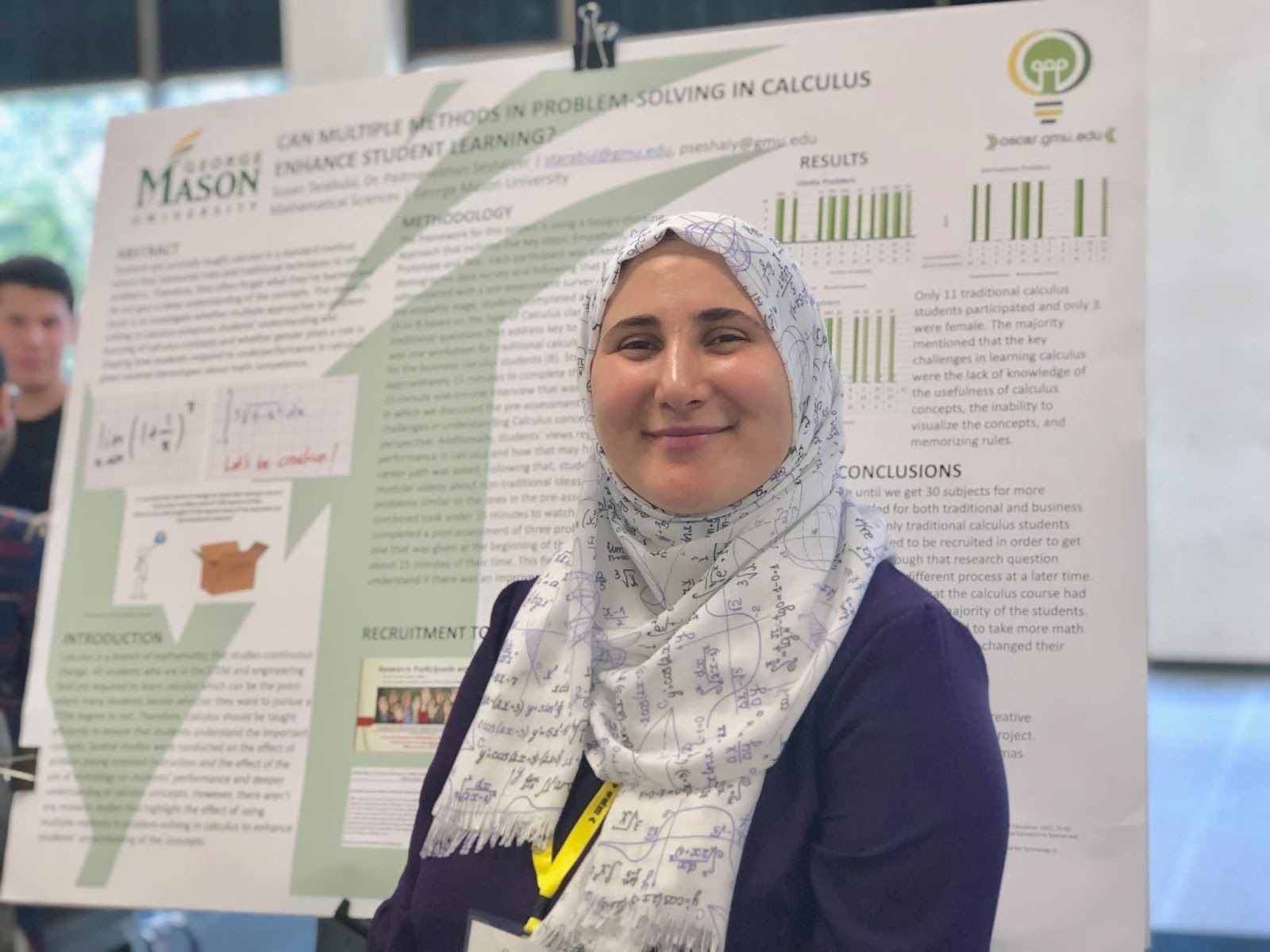
STIP Student Susan Tarabulsi Studies the Approach of Multiple Methods for Problem-Solving in Calculus to Enhance a Students’ Learning

Since I was 15 years old, the beauty of mathematics has always captured my attention. I have only experienced mathematics education in a single rigorous way and I have always striven to educate myself and others by engaging in mathematics through different, novel methods. I have been inspired by Dr. Padmanabhan Seshaiyer’s approach to problem-solving as well as the connections that he drew between mathematics and the real world which have motivated this project. In most classrooms, students are often encouraged to solve a problem by a fixed step by step approach. Students usually end up memorizing the steps without really understanding the mathematical concept, and therefore, they forget what they had learned after they complete their exams. Because of the lack of conceptual learning, mathematics fails to excite many students, and the traditional pedagogy does not engage students to think creatively. Perhaps, this is why many students have decided not to pursue a career in the STEM field after taking a calculus course. Therefore, improving the quality of mathematics education has become my personal goal. 

This project allowed me to demonstrate that thinking outside of the box in calculus has a positive impact on student success. Through this project, I investigated traditional approaches used in teaching Calculus topics and provided alternate inquiry-based and technology-based approaches to understand the same topics. A second topic that I wanted to investigate is whether gender plays an important role in shaping how students respond to under performance in calculus given societal stereotypes about math competence.

Saturday, December 7, 2019

STIP Student Avaanti Sridhar Researches Human Trafficking for Film Project


Human trafficking is one of the biggest issues internationally throughout the world. While many initiatives, task forces, and movements have been implemented in order to put a stop to it, trafficking still exists. My career goal is to be a narrative filmmaker with a focus on creating stories that combat social injustices throughout society. My final project will be a short fiction film that tells a story about a human trafficking victim and the aftermath of their experience. The development and preproduction will be conducted in the Fall/Winter of 2019, then in the Spring of 2020, the actual film will go into production.

Before even thinking about telling a story, a person must conduct lots of background research and know as many facts about an issue as they can. This summer, I spent most of my time at the library, focusing on reading books and personal accounts about trafficking experiences. I conducted a lot of research on the demographics of trafficking, such as where it occurs the most and what groups of people are targeted primarily. This type of information helps with building a story. My long term goal of being a social change filmmaker will be strongly supported if my project goes well this next year. I am hoping that my film will be powerful, and can lead me to more opportunities within the film and entertainment industry. Film is a very powerful medium that people of all ages can enjoy. That is why it is very important for people to use this form of art to tell stories and create positive change in the world.

On a weekly basis, I go to the library and do research on databases where I take notes and record information that I read. One thing that I discovered this term is that there are always two sides to every story, and it is crucial to look at and talk about both in order to tell a powerful story.

Thursday, December 5, 2019

STIP Student Davesh Purohit Begins Steps toward Direct Analysis in a Real Time Mass Spectrometer (DART-MS) to Detect Parkinson’s from a Patient’s Stench or Body Fluids

Hi, my name is Davesh Purohit and I am a Neuroscience major researching on Parkinson’s disease with my mentor-John Schreifels. I first heard about this project from John Schreifels, I was intrigued by his motivation to help his sister—who has Parkinson disease—by creating an instrument that can quickly detect the presence of the disease. Since there was no clinical method to detect the disease, I clearly saw the need for a process to detect the disease as a pre-med student since millions of Americans are affected by it every year. John Schreifels was diving into a theory that involved the usage of a Direct Analysis in Real Time Mass Spectrometer (DART-MS) to detect Parkinson’s from a patient’s stench or body fluids. So, when I decided to work with him on this research project, we purchased a DART-MS instrument and spearheaded the theory on our own. My goal for this research project was to become acclimated with the DART-MS by calibrating the instrument and conducting experiments to prove the instrument’s functionality. The DART-MS was designed to detect the molecular weight of any substance, so the goal for this instrument was to successfully detect the molecules that are responsible for creating a stench in a sample of Listerine mouthwash.

Throughout the semester, I communicated with my professor on a daily basis to order the right materials and assemble the DART-MS. Once the instrument was ordered and assembled, my weekly tasks would include calibrating the instrument, learning about the architecture, data processing, and software of the instrument. When the instrument was calibrated, I was successfully able to detect the molecules that were responsible for emitting a scent from the mouthwash. The next phase of our research is to apply this process to detect the stenches of apples, oranges, and stinkbugs for further verification of the instrument’s capabilities before we move onto trying to detect Parkinson’s disease in human trials. One thing I took away from this research project is the amount of help you can get from different companies, GMU faculty, and mentors if you simply ask for help. I would have never gotten this far in this research project if it weren’t for the assistance of my superiors. As I progress onwards with this research project, more questions will be asked than answers would be given; but I’m excited to see how this project will impact the scientific community in the future