Friday, August 26, 2022

URSP Student Ulda Maldonado-Arias Researches the Immigrant Paradox and Advantage

The research project I took on was to observe the immigrant paradox and immigrant advantage within the MSRP data set provided by my faculty advisor. The MSRP (Miami School Readiness Program) data set is 5-cohort, 14 year sequential project that observes children attend Miami Dade Public schools. This was influenced by my decision to join the honor’s psychology program at George Mason University. In this program as an undergrad, you choose to go through a mock thesis process. For three semester you must prepare a thesis document, propose it and finally defend it. During this process you will present to other in conferences/symposiums and work in a research lab.

During Covid-19 this was quite difficult because you could not really meet someone that shared your research interests in person. Not only that but a lot of research was put on hold. Finding someone who would be interested in mentoring you was quite hard. I didn’t lose hope and found Dr. Adam Winsler. I had learned about the immigrant advantage in my adolescent psychology course and found out that immigrants show greater resilience than U.S. born children, so I wanted to investigate that more. Dr. Adam Winsler loved the idea and explained some previous graduate students had also investigated the phenomena. After figuring out exactly what I was interested in, by examining various literature I decided to fill in the gap by looking at variation based on country of origin and solely compare immigrants to one another.

This project has lasted for about three semesters. In the beginning I spent 5-7 hours looking at the literature. During the summer and spring of 2021, I made drafts of my introduction/literature review. A total of 8 drafts were made! Dr. Winsler has helped with refining my writing skills which I am grateful for. Fall of 2021 it was time to defend and come up with the methods on how to go about data analysis for spring of 2022. I spent 8-10 hours on my project, as I was also applying for the OSCAR grant and the NCUR conference. I also went through a couple of versions for my methods section. Now it is finally spring of 2022 and I spend about 10 hours on my project a week. I have been cleaning data to make sure all the kids in my sample are included. Then data analysis has been done and interpretation of data. In a day I try to break time intervals for my project and schoolwork. If its exam week I reserve one day for my project and the other for studying.

This project has fit into my future plans as I wish to continue research on minorities within developmental psychology. This project will help open doors with all the skills I have acquired. I went from not knowing what a syntax file was in SPSS to knowing the difference between point and click and syntaxing (FYI makes the job easier). Next year I will be looking into graduate programs and this project will help with that by helping me refine my interests and stand out to schools. Now, that’s the long-term future, as for short term I hope to continue my project with different grade levels and hopefully publish before I end my undergraduate career as I work alongside the Winslab the research lab that has made this project possible

URSP Student Natasha Tagle Assesses the Redox Conditions in the North Pacific Ocean during the Warm Pliocene Epoch using Nitrogen Isotopes

Assessing past oceanic current patterns is very important to understanding and predicting the future of the Earth and its oceans. My research proposes that there was a deep-ocean current that occurred in the North Pacific Ocean. I used two core samples provided by the International Ocean Discovery Program (IODP). The project consisted of crushing the samples, weighing them out in a centrifuge tube, acidifying, rinsing the samples, drying them in an oven, reweighing, and homogenizing the samples into a powder again. From there, the samples were ready for nitrogen isotopic analysis at the University of Maryland (UMD). Working through this research project has been very interesting, each day came with its own challenges. This made the pacing of completing the research a greater lesson in time management, as well as adapting to new work environments & problem-solving. 

For example, one day will consist of a meeting to debrief on any information I am unfamiliar with, work through a few steps in the lab to prep my samples, and then head to class. Next, I’ll be doing readings for research, and then work for my second job, aside from my project, school, and another job. I have valuable weekly progress meetings with the entire research group. As a result, I have been able to learn more about the other research topics the other students have been working on. The last biggest step for this research is having the opportunity to present my project at the Joint North-Central & Southeastern Section in April 2022 for the Geological Society of America (GSA). Thus far, I have gained much more knowledge throughout the process of having a research project than I thought possible, and am looking forward to any opportunities that may come forth as a result of this project

Thursday, July 28, 2022

URSP Student Ayman Slamani Researches Brain-Computer Interfaces (BCIs)

The brain is arguably the most important organ in the human body but even in this day and age we know so little about it. My name is Ayman Slamani and I am a senior majoring in Bioengineering, with a concentration in pre-health. I have always been a curious person to the core, and I seek to learn the most that I can about topics that pique my interest. The topic that has interested me the most, since learning about Ben Carson’s revolutionary neurosurgery while watching the movie Gifted Hand, has been the brain. This is why my ultimate career goal is to become a neurosurgeon and why I chose to focus my research on brain-computer interfaces (BCIs).

Most of the current research studies regarding BCIs use electrocorticography (ECoG). This is due to the necessity of gathering high resolution electrical activity from the brain to allow for easier manipulation of data gathered and the specialization of that data. The issue with this method is that it is very invasive, requiring the implantation of a microelectrode array on the surface of the brain. This comes with many risks for the patient. 

Electroencephalography (EEG) is a non-invasive method of collecting electrical activity of the brain. Because it involves collecting electrical signals via electrodes on top of the scalp, the signal is attenuated. This research area is still in its infancy in terms of what has been accomplished. That’s I chose to use EEG signals for my research

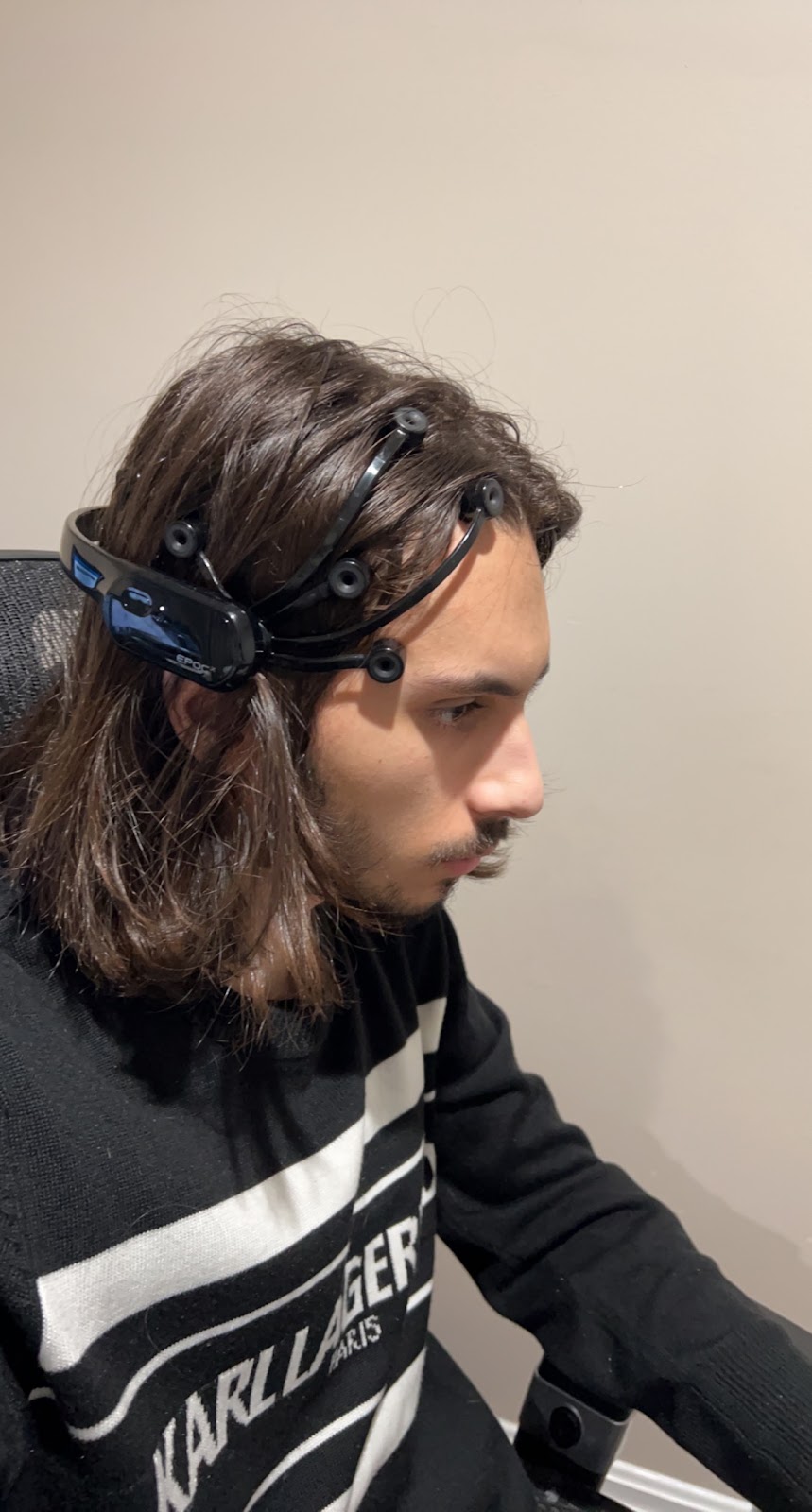
I am currently working with my mentor, Dr. Siddartha Sikdar, to develop a brain computer interface that integrates the use of an EEG headset with a predictive algorithm built to manipulate the grasping actions a prosthetic hand. My research so far has been looking at precedent in this area of study as well as how to process EEG data through MATLAB and adjunct software. The EEG headset that I will be using for this study just came in and I am excited to start data collection and work on the algorithm side of this research. These will be the most important steps in producing a working BCI.

URSP Student Garret Rich Investigates if Elephant Toenails can be Utilized for the Monitoring of Long-term Hormone Patterns

Over the course of the fall and spring semesters, I have been working with Dr. Elizabeth Freeman and Dr. Kathleen Hunt on a project to identify if elephant toenails can be utilized for the monitoring of long-term hormone patterns.

Traditionally, urine, feces, and blood have been used for monitoring hormones. One of the main drawbacks of traditional samples is that they reflect short periods of hormone information. This can be problematic for species like elephants as they undergo long-term fluctuations in hormones (for example, three month long estrous cycles), which may not be as easy to detect with the day-to-day variation of traditional samples. Toenail samples attracted our interest as their slow growth may better capture fluctuations that occurred over weeks and months.

Throughout this semester, we have worked on processing toenail samples to determine their hormone concentrations. We are currently working on running samples from three African elephants (two females and a male) collected across the span of a year. My typical lab work includes pulverizing samples, doing hormone extractions, and testing hormone extracts to quantify concentrations of testosterone, progesterone and cortisol. All three hormones turned out to be highly detectable from toenail extracts and have had no issues passing verification tests. Even more exciting, variations in hormones have been preserved in our toenail samples and the variations do line up with our physiological expectations for the individual elephants (e.g., dramatic fluctuations in progesterone in a female known to be cycling, and periods of high testosterone in the male). By the end of the semester, we will have finished our data analysis of hormone concentrations with African elephants and begun work to publish the results.

I feel very fortunate to have worked on this project so far. I am interested in animal physiology and have considered possibly attending veterinary school after finishing my undergraduate degree. This project has given me the unique opportunity to work with endangered species while also giving me hands-on skills used in investigating animal physiology. In the future we plan to continue our analyses with Asian elephant toenails and will present our work at relevant conferences.


URSP Student Isabella Meerzaman Investigates whether BAX or Bax Inhibitor 1 (BI-1) suppresses Endoplasmic Reticulum (ER) stress induced cell death in Idiopathic Pulmonary Fibrosis

Clinical research has led to novel treatment options that offer patients a glimmer of hope by improving and extending their quality of life. The ability of scientists and researchers to map disease-causing pathways to identify inhibitors/activators that slow or stop disease progression has provided the medical community with a new treatment arsenal. Idiopathic pulmonary fibrosis (IPF) is a fatal lung disease that affects 3 million individuals globally. IPF causes excessive permanent scarring of the lungs known as fibrosis, making it hard for proper gas exchange to occur.

I have been working in Dr. Grants lab focusing on a project that investigates whether “BAX or Bax Inhibitor 1 (BI-1) suppresses Endoplasmic Reticulum (ER) stress induced cell death in Idiopathic Pulmonary Fibrosis.”. ER stress is induced in IPF cells, then BI-1, BAX or both are silenced to see if sensitivity to ER stress is altered. If BI-1 or BAX can suppress ER stress induced cell death, it could critically alter IPF treatment and provide a possible pathway framework to target. This project has allowed me to gain more experience with bench based lab research and data analysis. Working in Dr. Grants lab has helped prepare me for my post bacc research fellowship with the Department of Defense and my future career as a clinical research physician.

Sunday, July 10, 2022

URSP Student Violetta Rostobaya Studies the Mechanical and Tribological Properties of 3D printed PLA+HA Composite


My name is Violetta Rostobaya and I am a senior mechanical engineering student at Mason. I have been working on material science project under mentorship of Dr. Ali Beheshti and Dr. Shaghayegh Bagheri since Fall 2021.  This research project became an important step in my journey as an engineer and a researcher. I am very grateful to both of my mentors and URSP program for the opportunity to participate in undergraduate research and become an active member of Mason engineering research community. My average day at a lab starts with preparing the polymer material for extrusion. Sometimes depending on the method of manufacturing it can take up to several days for the mixture to prepare before the extrusion. 

This process is tedious and requires a lot of patience, precision as well as lab equipment management skills, which I did not have at the start of this project. This semester however I feel more confident and have clearer direction of the project. After the material is extruded, the produced filament is used to 3D print samples for compression and indentation testing.

My next steps are finishing up the production process and testing the samples. The results of the tests will be summarized and analyzed in a research paper. I hope to publish the paper in an academic journal and launch my researcher career. I am planning to start my graduate school in Fall 2022, so I hope this work will provide me some recognition within scientific community.

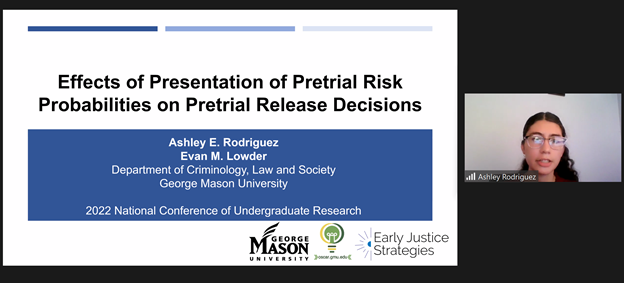
URSP Student Ashley Rodriguez Examines the Effects of Presentation of Pretrial Risk Probabilities on Pretrial Release Decisions


Jurisdictions across the U.S. are increasingly using risk assessment tools to standardize every defendant’s risk to community safety which informs pretrial decision-making. One often overlooked area of risk assessment research is how risk assessment information is communicated to decision-makers.

The goal of my project is to examine whether presenting risk assessment information as a fixed or variable probability effects pretrial decision-making. Under the supervision of my mentor, Dr. Evan Lowder, I created eight vignettes to simulate the information a typical pretrial actor would receive during a pretrial hearing. These vignettes varied by risk assessment score and whether the offense was violent. I created one questionnaire for all participants to answer. I uploaded my vignettes and questionnaire to Qualtrics. Next, I recruited judges, pretrial officers, defense attorneys, and prosecutors through locating publicly available contact information for their offices or through professional associations.

An average day this half of the semester involves me continuing to recruit more participants in order to increase my sample size and to obtain a more geographically representative sample. I am also in the process of perfecting an R script to clean and graph the data and creating a Stata script to analyze the data. Finally, I am refining my manuscript to hopefully send to publication.

I fell in love in research when I began working with Dr. Lowder on my own independent research project and with other projects within the Early Justice Strategies Lab. I decided a year ago that I wanted to do research permanently which led me to applying to various criminology doctoral programs last semester. I used an enhanced version of this project’s proposal as my writing sample to these various schools to illustrate my desire to conduct research. I believe that this project was one of many factors that led me to my admission to numerous funded criminology doctoral programs. Through conducting this research project this semester, I will have a stronger skillset and overall experience when I begin my doctoral journey next semester.


URSP Student Daniel Hernandez Analyzes the Surface Degradation of Additively Manufactured (AM) ABS Polymers for Naval Application

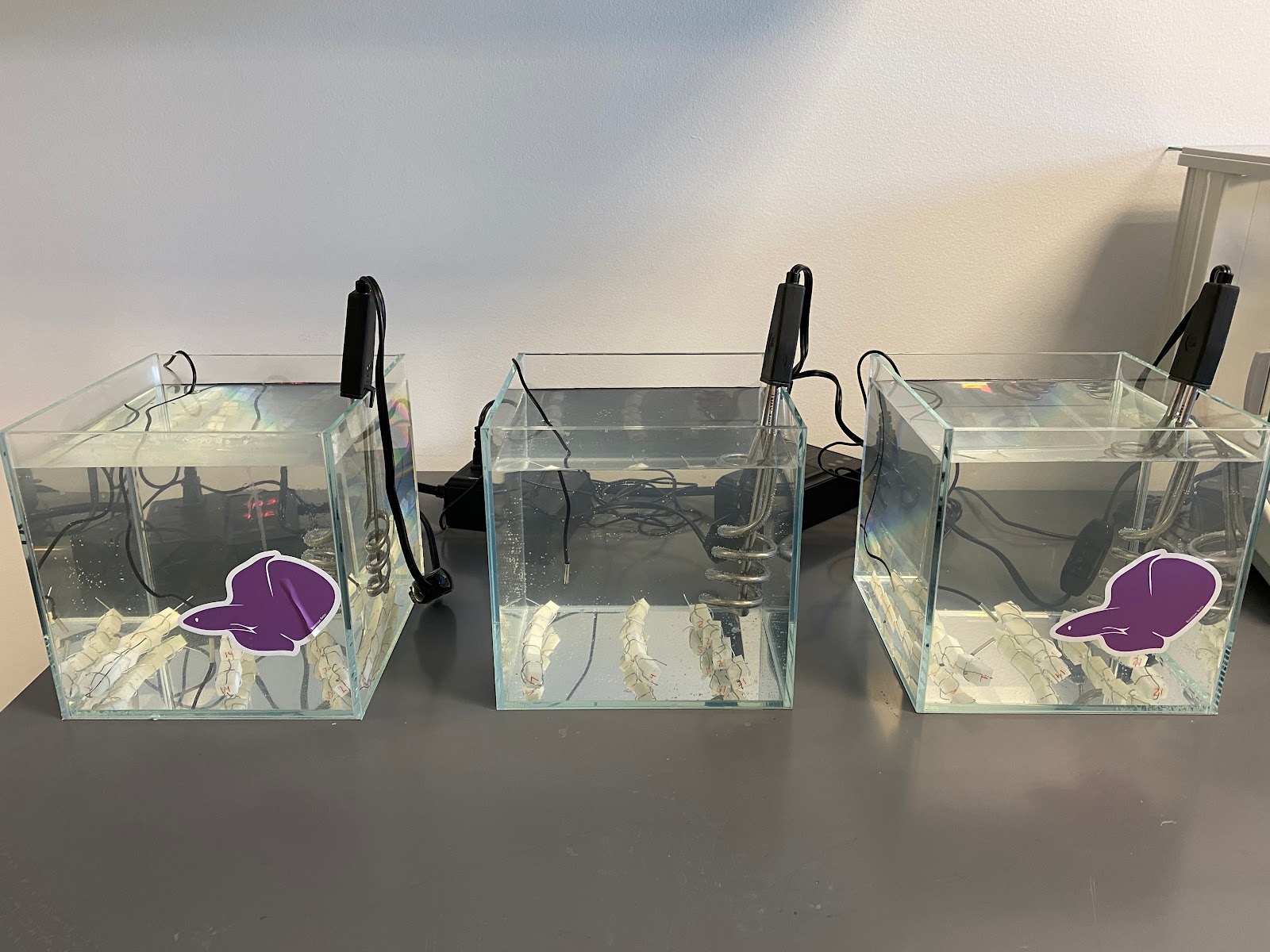
My name is Daniel Hernandez, I am a junior at George Mason University working with Dr. Ali Beheshti to analyze the surface degradation of additively manufactured (AM) ABS polymers for naval application. This project is a continuation of my work done in the summer semester to determine the viability of AM ABS polymers in a saline environment in comparison to their traditionally manufactured counterpart. Where the main focus this semester has been the aging of the ABS samples and observing the changes in the surface topography. The aging chambers consisted of tanks filled with artificial seawater heated to 22°C, 27°C, and 105°C accordingly using a water heater with set submerged durations of 7, 14, and 21 days. My day-to-day interactions consist of ensuring the proper levels of seawater in the tanks and recording the change in mass of the samples. Currently, only half of the samples have been aged though the remainder is set to be finished soon.

The next steps are to assess the surfaces of the samples through micro indentation and profiling tests. These tests will allow for the observation of the change in wear and friction of the surfaces as well as the Young’s Modulus of the samples. Given if time permits mechanical and tribological evaluations will be done on the ABS samples to observe the change in mechanical strength and serve as another method of observing the surface topography of the samples.This has been a rather engaging experience that has allowed me to pursue my interest in the naval engineering field. Furthermore, working with Dr. Beheshti has allowed me to gather a sense of the lab working environment and has compelled me to develop my understanding of the 3D printing process and corrosive behavior of the ocean through whichever future opportunities may be presented.

Sunday, July 3, 2022

URSP Student Tulane Simpson Uses Popular Cartoon to Reimagine Intersection of Environmentalist Theory and Gender Expression


My research involves using popular media as a tool to separate environmentalist practice from the gender binary. Historically, environmentalism has been divided along binary gender lines, as in the cases of ecofeminism and ecomasculinity which use one’s gender as the basis for environmental attitudes. Since environmentalism should be inclusive of all people regardless of gender, I’ve spent this semester developing the environmental theory of ecoandrogyny as an environmental framework that is inclusive of all gender expressions. As popular literature and media are powerful tools or sharing environmental values, especially to young people, I identified Nickelodeon’s Avatar: The Last Airbender as an example ecoandrogynous text for its nuanced depictions of both environmental practice and gender expression.

I have been fortunate to receive an array of support on this project. My URSP funding has allowed me to attend academic conferences where I could meet and learn from other scholars in my field. As I am completing this project in conjunction with Mason’s English Honors thesis course, I received additional assistance with discipline-specific research and drafting issues.

Completing this project will help me reach my future goals of continuing my education and becoming a college-level educator. Not only can my completed paper serve as a writing sample for graduate school applications, I have also gained a strong background in advanced research and writing techniques that will serve me well in my future academic and professional work. Additionally, working with so many outstanding professors, scholars, and library staff has given a better understanding of what I look for in a mentor. This knowledge will help inform my own teaching and mentorship style so that I can serve my future students to the best of my ability.

Sunday, December 19, 2021

Sisc Johnson Created an Adolescent Mentorship in Detention Facilities and Alternative Learning Spaces

For my research project, I created a mentorship program to teach photography and text in alternative learning spaces to court involved youth. Desired outcomes include fostering and promoting positive self-esteem by developing new skill sets acquired from learning the technical and creative skills of photography.  This process also results in promoting positive and respectful communication skills as students learn how to write about and critique their work and the work of others.

This summer I spent three days each week working with 3-5 residents at Stepping Stones. Stepping Stones is a community-based, non-secure residential treatment program for male court involved youth, ages 14-17 that is located in Fairfax County, Virginia.

After our first session each resident was provided with a DSLR camera, two lenses, and a portable flash drive. During our sessions the program participants learned how to operate a DSLR camera. They also learned how to select the appropriate lens and the fundamentals of composition and lighting. Lessons also included instructions on how to upload images from memory cards to Adobe Lightroom and how to edit images in Adobe Photoshop.

The first session of each week would typically begin with a critique of their work from the prior week. The remainder of our time was spent photographing, scrapbooking, creating cyanotypes, and/or learning about other camera-based processes and influential photographers. For the final week of my program, we will have an exhibition showcasing their work to their families.

From my observations throughout the project, I feel that to continue my program in the future a few adjustments could be made in the following ways. For instance, it was difficult having only a single laptop when uploading and editing images with a group of five participants. This was time consuming because I could only work with one participant at a time. Also having an assistant would be beneficial for providing more one-on-one time with each participant. Fortunately, the entire staff at Stepping Stones are vested in the success of each resident, and they were not only very helpful with their ideas and suggestions throughout my program, but I learned a great deal from them regarding how to better handle challenging moments. Because the staff supported me and their residents throughout my entire program, this also added to my awareness regarding what things might be of more interest to the participants.

Measuring the long-term success of my program will not be possible for a few years. As for measuring short term success, I observed drastic improvement not only in their work, but in their behavior. They began dressing up for our sessions becoming more confident behind and in front of the camera. The participant’s critique of their work and the work of others was also impressive and very respectful.

In the future, I plan to continue my work with the adjustments noted above. A few years from now I will reach out to each participant to measure the success of my program.


URSP Student Mounia Hammadi Studies the Potential Effects that Endoparasites Have on Feeding Habits of Their Crab Hosts

The survival of a species of mud crab along the East Coast of the U.S., known as the Rhithropanopeus harrisii (Harris mud crab), is being tested by a multitude of factors, including the continued fluctuations in salinity that result from the estuaries it resides in and the ever-changing levels of parasitism in different locations along the coast. The biotic pressure of parasitism is influential on not only the survival of R. harrisii but also the trophic structure of its community. The two most prevalent parasites that cause a significant role in the survival of the Harris mud crab community include the castrating parasitic barnacle, Loxothylacus panopaei, and the lesser-known parasitic entoniscid isopod, Cancrion sp. Parasitic castration means that L. panopaei inhibits the organism’s ability to reproduce. 

However, since Cancrion sp. is considered a new species, there is minimal evidence suggesting complete parasitic castration of R. harrisii. This summer I have been working in Dr. Amy Fowler’s lab at the GMU Potomac Science Center answering the question, do these endoparasites affect the feeding habits of their crab hosts? We suspect that the intense energy drain of being infected with these endoparasites leads to changes in the feeding behavior of R. harrisii. Luckily, the COVID-19 restrictions have begun to loosen, allowing me access to the laboratories to run a multitude of feeding trials on a total of 25 uninfected crabs, 8 infected with entoniscid (Cancrion sp.), and 11 infected with L. panopaei where feeding behaviors are accessed for 45 minutes. The collection of these crabs has been done from three main sites: Boathouse Marina in Colonial Beach, VA, Garrett’s Marina in Dunnsville, VA, and near the Choptank River Bridge in Cambridge, MD. This summer, an interesting observation I had was that the mud crabs can be the host to both parasites at the same time, as shown by an individual crab that acquired L. panopaei externa (sac on the abdomen of the crab that holds thousands of parasitic larvae) as well as released Cancrion sp. larvae. How double infections affect R. harrisii’s feeding habits is still yet to be determined. Another interesting observation was that gravid crabs (those with fertilized eggs) and crab hosts infected with Loxothylacus panopaei in the externa phase will both not molt to minimize loss of its eggs or parasitic externae. However, it has been shown that the crabs infected with the entoniscid do continue to frequently molt where its infection does not inhibit its ability to grow. Although trials are still being run and the data has yet to be properly analyzed, what has been obtained so far is extremely interesting and will further be looked upon during the Fall 2021 semester.

Friday, December 10, 2021

Amanda Graf Studies Multiplexed Antigens on DNA Nanoparticles for Vaccine Development


Vaccines and the technologies used to develop them are more relevant now than ever. If you had asked me or my colleagues a year ago, none of us would have ever guessed that vaccines would be the global hot topic they are now.

After taking Dr. Veneziano’s tissue engineering class, I met with him to discuss the research going on in his lab and discovered that he has been working on DNA nanoparticles with the intention of using them in a vaccine for several years now. The process of making these 3D nanostructure scaffolds begins with isolating and purifying single stranded DNA.  I typically do this right when I get to the lab each morning using an aPCR machine (antisense polymerase chain reaction) and then isolate the single stranded DNA that results from that using gel electrophoresis and a centrifuge with elution buffer to isolate the single stranded DNA from the other byproducts. From there, I fold the protein into the desired shape and test its binding capabilities.  Throughout the rest of the summer and into the fall semester, I will be testing the binding rates of my desired nanoparticle with varied antigen properties and attachment configurations.

 This project has been very insightful and ties directly into my future plans to become a physician, possibly specializing in infectious diseases.  Working with Dr. Veneziano has allowed me to develop a better understanding of not only what it’s like to work in a wet lab but has also compelled me to further explore topics outside of my normal course of study and think more about what advancements could be made through supplementary research in the field of platform vaccine development.

Dhruv Participates in the 2021 COVID-19 Human Behavior Research Project

My name is Dhruv Gandhi, I am a Senior at George Mason University working on a research project titled, “Data-Driven Analysis of Human Behavior in COVID-19 Simulation Models.” I had no idea what this internship would be like, not only because of the coronavirus, but also because this is my first summer being part of a research project. Surprisingly, COVID didn’t affect the internship too much as we always had our scheduled meetings and interacted with all the other team members fairly frequently. At the beginning of the internship, a typical day would start with an hour-long meeting in the morning with each group updating the professors and the other groups about their progress. Then we would have our goals set for the day, which we would work on with our other group members. Most exciting part was the weekly hybrid meeting on Fridays because there was always a stock of donuts and coffee. Working with people with varying background working towards the same goal and learning every week about something you had never heard of before made this internship incredibly exciting. I was able to learn and implement techniques that I had thought to be too complex previously because I had professors and other group members to help me through the process. This internship was able to give me not only confidence about my abilities to contribute in a professional setting, but also taught me how to work in a professional setting and network with others. I believe this internship has done a great job of giving me a taste of what’s to come after I graduate from George Mason.

For the research, my group is developing a location predication algorithm using data from SafeGraph. The data contains 650 different geographical subsections of Fairfax County called census block groups (Tysons, West Springfield, etc.) and over 15,000 POIs which are places of interests such as malls, barber shops, and restaurants. Our goal is to create an algorithm that accurately predicts the number of visitors to a POI from a CBG for the next few weeks. This project is incredibly interesting to me because it applies a lot of the techniques I have learned in classes throughout my time at George Mason.

Sunday, October 17, 2021

URSP Student Selassie Fugar Researches Multiple ways to Support the Bailey's Culmore Community

The Culmore neighborhood of Bailey’s Crossroads is an area located in Fairfax County, Virginia. As one of the most disadvantaged places in Northern Virginia, this area consists of many different types of people from the Latinx community as well as other races and ethnicities. Kaiser Permanente plays a big role in fostering the vision to build a better community in Culmore. Due to the grant that was given to George Mason University and CASA de Virginia, creating a vision for Culmore that improves their community based on the social determinants of health is more achievable.

My research focuses on food insecurity and providing what people need and what to eat in the community. My main focus amongst food insecurity is how to make people in the community comfortable with receiving free food and how to reduce unhealthy lifestyles as well. One way of fostering healthy lifestyles is providing access to free or cheaper healthy foods through connections with different farms and gardens with certain faith-based organizations. Another way we could foster healthy lifestyles is to set up cooking classes for people who don't know how to use healthy food.

From this project I have learned how to better communicate with others and how to assume that everyone I interview will be friendly instead of the opposite. Developing conversational skills will improve my outlook on this project and help me remember that it is not what I think is best for the community but what the community wants for themselves.

Reagan Emmerling Researches Gender Differences in those Participating in OSCAR Research Projects

I decided to join a summer research project because I knew how much it would benefit my future. I hope to one day become a college professor with heavy focuses on research and writing. Being part of a summer project was an easy, and highly beneficial, way to know if this career path suited me, and I am happy to announce that it did. I worked entirely virtual this summer in my research project, which completely changed my view on what my work could be and mean. I was able to take my research with me to amazing places, such as Acadia National Park, Myrtle Beach, my home in Ohio, and so much more. My summer would have looked so different had I not been able to work virtually, and I am so thankful that I was able to work remotely rather than being stationary in Virginia.

My original plan for my summer research was to cover on-campus living conditions during the pandemic, but then shifted to issues of housing instability in college student populations. I ended up on a project researching the massive gender difference in who is participating in OSCAR research projects. To briefly wrap up a summer’s worth of work in barely a sentence; roughly 7/10 of researchers in OSCAR over the past 10 years have been women, but George Mason is divided almost 50/50 in terms of gender. This tells us that something is drawing drastically more women to research programs, and we wanted to find out why. It turned out that other universities saw a similar trend in their participation rates as well.


My next steps are to return to campus in the fall as a junior, where I am majoring in Integrative Studies with a concentration in Women and Gender studies. I will be working on campus as a MASI peer mentor and as a research assistant mapping the 1926 Religious Bodies Census. I hope to find myself involved with more research projects and gain even more experience in my field. Following graduation, I plan to attend graduate school in Colorado, where I have already started looking at programs with a masters in Women’s History. I am very thankful for this amazing opportunity and hope to work with OSCAR in future projects.

Tuesday, September 28, 2021

URSP Student Daniel Hernandez Analyzes the Surface Degradation of Additively Manufactured (AM) ABS Polymers for Naval Application.

This summer, I worked with Dr. Ali Beheshti to analyze the surface degradation of additively manufactured (AM) ABS polymers for naval application. The aim of my studies was to determine the viability of AM ABS polymers in a saline environment in comparison to its traditionally manufactured counterpart. As of recently I have been working on a literature review as well as an experimental plan for the project. I also printed 20 rectangular ABS samples and ordered 20 traditionally manufactured parts from a plastic manufacturer. A typical day of research consists of me searching for articles while managing the printing of the ABS samples. In the remaining timeline of the project, the samples will be aged accordingly for a set duration of 4, 8, and 16 days in tanks filled with artificial seawater. The tanks will be heated to 22°C, 27°C, and 105°C accordingly using a water heater. After undergoing the appropriate exposure time, the topography of the sample surfaces will be assessed and compared with the initial data collected prior. If time permits mechanical and tribological evaluations will be done on the ABS samples to observe the change in mechanical strength, wear and friction of the surfaces.

My main interest is robotics with a sub interest of ocean engineering. Additive manufacturing (3D Printing) has had transformative effects on the performance and technology of many industries. In the robotics industries, additive manufacturing has contributed to the development of emerging fields such as soft robotics due to its ability to create flexible and creative designs at high quality. This project was the perfect learning opportunity for me because it has allowed me to gain an in depth understanding of the 3D printing process as well as the corrosive behavior of the ocean. Moreover, since I plan to obtain a master’s in mechanical engineering in the future this research has been an essential step towards that goal.  I have enjoyed learning about the degradation of ABS in a naval application and hope to continue this research in the future.

Monday, September 27, 2021

URSP Student Mounia Hammadi Studies the Potential Effects that Endoparasites Have on Feeding Habits of Their Crab Hosts

The survival of a species of mud crab along the East Coast of the U.S., known as the Rhithropanopeus harrisii (Harris mud crab), is being tested by a multitude of factors, including the continued fluctuations in salinity that result from the estuaries it resides in and the ever-changing levels of parasitism in different locations along the coast. The biotic pressure of parasitism is influential on not only the survival of R. harrisii but also the trophic structure of its community. The two most prevalent parasites that cause a significant role in the survival of the Harris mud crab community include the castrating parasitic barnacle, Loxothylacus panopaei, and the lesser-known parasitic entoniscid isopod, Cancrion sp. Parasitic castration means that L. panopaei inhibits the organism’s ability to reproduce. However, since Cancrion sp. is considered a new species, there is minimal evidence suggesting complete parasitic castration of R. harrisii. This summer I have been working in Dr. Amy Fowler’s lab at the GMU Potomac Science Center answering the question, do these endoparasites affect the feeding habits of their crab hosts? We suspect that the intense energy drain of being infected with these endoparasites leads to changes in the feeding behavior of R. harrisii. Luckily, the COVID-19 restrictions have begun to loosen, allowing me access to the laboratories to run a multitude of feeding trials on a total of 25 uninfected crabs, 8 infected with entoniscid (Cancrion sp.), and 11 infected with L. panopaei where feeding behaviors are accessed for 45 minutes.

The collection of these crabs has been done from three main sites: Boathouse Marina in Colonial Beach, VA, Garrett’s Marina in Dunnsville, VA, and near the Choptank River Bridge in Cambridge, MD. This summer, an interesting observation I had was that the mud crabs can be the host to both parasites at the same time, as shown by an individual crab that acquired L. panopaei externa (sac on the abdomen of the crab that holds thousands of parasitic larvae) as well as released Cancrion sp. larvae. How double infections affect R. harrisii’s feeding habits is still yet to be determined. Another interesting observation was that gravid crabs (those with fertilized eggs) and crab hosts infected with Loxothylacus panopaei in the externa phase will both not molt to minimize loss of its eggs or parasitic externae. However, it has been shown that the crabs infected with the entoniscid do continue to frequently molt where its infection does not inhibit its ability to grow. Although trials are still being run and the data has yet to be properly analyzed, what has been obtained so far is extremely interesting and will further be looked upon during the Fall 2021 semester.

STIP Student Elaine Borresen Creates a Unit Plan and Activities for Physical Education Instruction while Integrating STEM

The goal for this Summer Team Impact Project is to present a unit plan and activities for physical education instruction while integrating STEM content. We found that integrating STEM topics is extremely beneficial for students. Students can get extra time exploring their classroom content. Our hope is that this integration can also pique interest in activities for those who may not usually be as engaged during PE. Using Virginia Standards of Learning, we sought to combine relevant science topics for K-12 students with games to develop their basketball, pickleball and softball skills. This plan is flexible, for teachers to use this unit plan in its entirety, or use lesson activities and games as they see fit. My particular contribution was towards the STEM content in the softball unit.

 This project fits into my future plans as a nurse and an Army officer by contributing how to plan with various factors and reinforcing my knowledge in STEM and biomechanics in particular. An average research day consists of a zoom meeting with all undergraduate and graduate students then breakout sessions with our individual groups to continue work on our unit plans. We had one day in the gym to test out some physical education activities and record ancillary materials for teachers. Something that I have discovered through this project is how complicated it is to create a unit and lesson plans. There are so many things that go into creating them. This project was different than it would have been if it were face to face because a majority of this was done virtually with all of us in different states, this was very cool since we were able to travel and still do research and work on the project. My next steps are to take the knowledge I learned from this project and apply it anyway I can to nursing school and Army ROTC.

Jack Blumstein Studies the Sociodemographic Factors that Impact Vaccine Uptake Across the US

Covid 19 has greatly impacted the world. With the implementation of vaccines, the impact of covid on the world has been greatly reduced, but there are many people who refuse to get vaccinated which allows covid to have a larger impact on the world than it would if those people who refuse to get vaccinated get vaccinated. My research project looks at the sociodemographic factors that impact vaccine uptake across the US. We recently ran a multivariate geographically weighted regression which creates a regression model that takes geographical location and distance into account when making the model. The geographical component causes the model to be more accurate than a simple linear regression. We are planning on using this regression model to predict vaccine uptake on the census block group level and then use a “local indicators of spatial association” analyses to find census block groups that are local outliers in vaccine uptake. We can then look at these local outliers and determine which census block groups are more at risk which should be able to help counties decide where they need to focus their efforts on increasing vaccine uptake.

There were many techniques, such as multivariate geographically weighted regression, that we used to analyze data that I had never heard about before starting this research project. I had a very good time learning about these techniques and implementing them because I have an interest in data analyses and playing with data. This research project has helped me learn more about data analyses in an out of classroom setting which should help me a lot in the future.

An average research day starts off with a meeting in the morning where the members in my group update each other on what has been done and what we want to do next. After this meeting, we separate to work on whatever we need to get done that day by ourselves. Sometimes we will have a meeting towards the end of the day to update the group on our progress.

Sunday, September 19, 2021

Lina Alkarmi Conducts Stability Studies of Lipid Nanoparticles Using Analytical Chemistry

Messenger RNA (mRNA) sequences can be engineered to encode certain proteins that can be translated and expressed within cells. Lipid nanoparticles (LNPs) are used to package mRNA payload for delivery in vaccines. The four lipid components of LNPs are an ionizable cationic lipid, a neutral helper lipid, cholesterol, and a PEGylated lipid. My research focuses on the synthesis and purification of ionizable lipids used to formulate LNPs. The storage temperature and time stored play a large role in the stability of LNPs as the mRNA can degrade, rendering the LNPs ineffective. Research suggests that the lipid components of the LNPs may degrade over time as well1. Over the past semester, I have developed a method to test the stability of the lipid components of LNPs stored at 4°C, 25°C, and 37°C.

After LNPs are formulated, the encapsulated mRNA can be extracted from the nanoparticles for analysis. The extraction method results in an aqueous phase containing the mRNA, as well as an organic phase containing the four lipid components. For my project, I examined the extracts from LNPs stored at 4°C, room temperature (25°C), and 37°C over the course of 3 weeks.

For each week of the 3-week stability study, I used thin layer chromatography (TLC) to qualitatively examine the aqueous and organic extracts from the LNPs stored at each temperature. Liquid chromatography mass spectrometry (LCMS) spectra were analyzed to observe the fragmentation of the compounds. Nuclear magnetic resonance (NMR) spectra were also used to examine the molecular structure of the compounds.

A typical day of research is arriving at the lab and checking on synthesis reactions set up the night before. Typically I will run three columns each day as well as run my samples on the LCMS. My research experience has been exciting, challenging, and rewarding. I am interested in the field of bioengineering so this project fits into my future plans of attending graduate school.

    1.)European Medicines Agency, Committee for Medicinal Products for Human Use (CHMP);                     Assessment Report, Covid-19 Vaccine Moderna. 2021