Sunday, July 10, 2022

URSP Student Violetta Rostobaya Studies the Mechanical and Tribological Properties of 3D printed PLA+HA Composite


My name is Violetta Rostobaya and I am a senior mechanical engineering student at Mason. I have been working on material science project under mentorship of Dr. Ali Beheshti and Dr. Shaghayegh Bagheri since Fall 2021.  This research project became an important step in my journey as an engineer and a researcher. I am very grateful to both of my mentors and URSP program for the opportunity to participate in undergraduate research and become an active member of Mason engineering research community. My average day at a lab starts with preparing the polymer material for extrusion. Sometimes depending on the method of manufacturing it can take up to several days for the mixture to prepare before the extrusion. 

This process is tedious and requires a lot of patience, precision as well as lab equipment management skills, which I did not have at the start of this project. This semester however I feel more confident and have clearer direction of the project. After the material is extruded, the produced filament is used to 3D print samples for compression and indentation testing.

My next steps are finishing up the production process and testing the samples. The results of the tests will be summarized and analyzed in a research paper. I hope to publish the paper in an academic journal and launch my researcher career. I am planning to start my graduate school in Fall 2022, so I hope this work will provide me some recognition within scientific community.

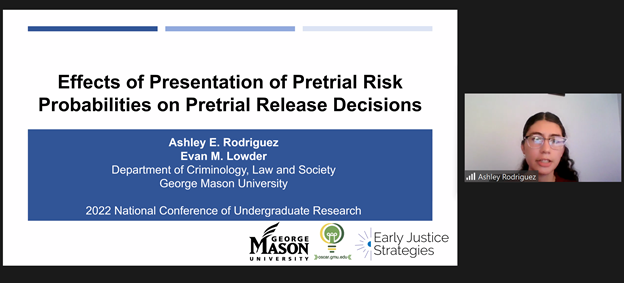
URSP Student Ashley Rodriguez Examines the Effects of Presentation of Pretrial Risk Probabilities on Pretrial Release Decisions


Jurisdictions across the U.S. are increasingly using risk assessment tools to standardize every defendant’s risk to community safety which informs pretrial decision-making. One often overlooked area of risk assessment research is how risk assessment information is communicated to decision-makers.

The goal of my project is to examine whether presenting risk assessment information as a fixed or variable probability effects pretrial decision-making. Under the supervision of my mentor, Dr. Evan Lowder, I created eight vignettes to simulate the information a typical pretrial actor would receive during a pretrial hearing. These vignettes varied by risk assessment score and whether the offense was violent. I created one questionnaire for all participants to answer. I uploaded my vignettes and questionnaire to Qualtrics. Next, I recruited judges, pretrial officers, defense attorneys, and prosecutors through locating publicly available contact information for their offices or through professional associations.

An average day this half of the semester involves me continuing to recruit more participants in order to increase my sample size and to obtain a more geographically representative sample. I am also in the process of perfecting an R script to clean and graph the data and creating a Stata script to analyze the data. Finally, I am refining my manuscript to hopefully send to publication.

I fell in love in research when I began working with Dr. Lowder on my own independent research project and with other projects within the Early Justice Strategies Lab. I decided a year ago that I wanted to do research permanently which led me to applying to various criminology doctoral programs last semester. I used an enhanced version of this project’s proposal as my writing sample to these various schools to illustrate my desire to conduct research. I believe that this project was one of many factors that led me to my admission to numerous funded criminology doctoral programs. Through conducting this research project this semester, I will have a stronger skillset and overall experience when I begin my doctoral journey next semester.


URSP Student Daniel Hernandez Analyzes the Surface Degradation of Additively Manufactured (AM) ABS Polymers for Naval Application

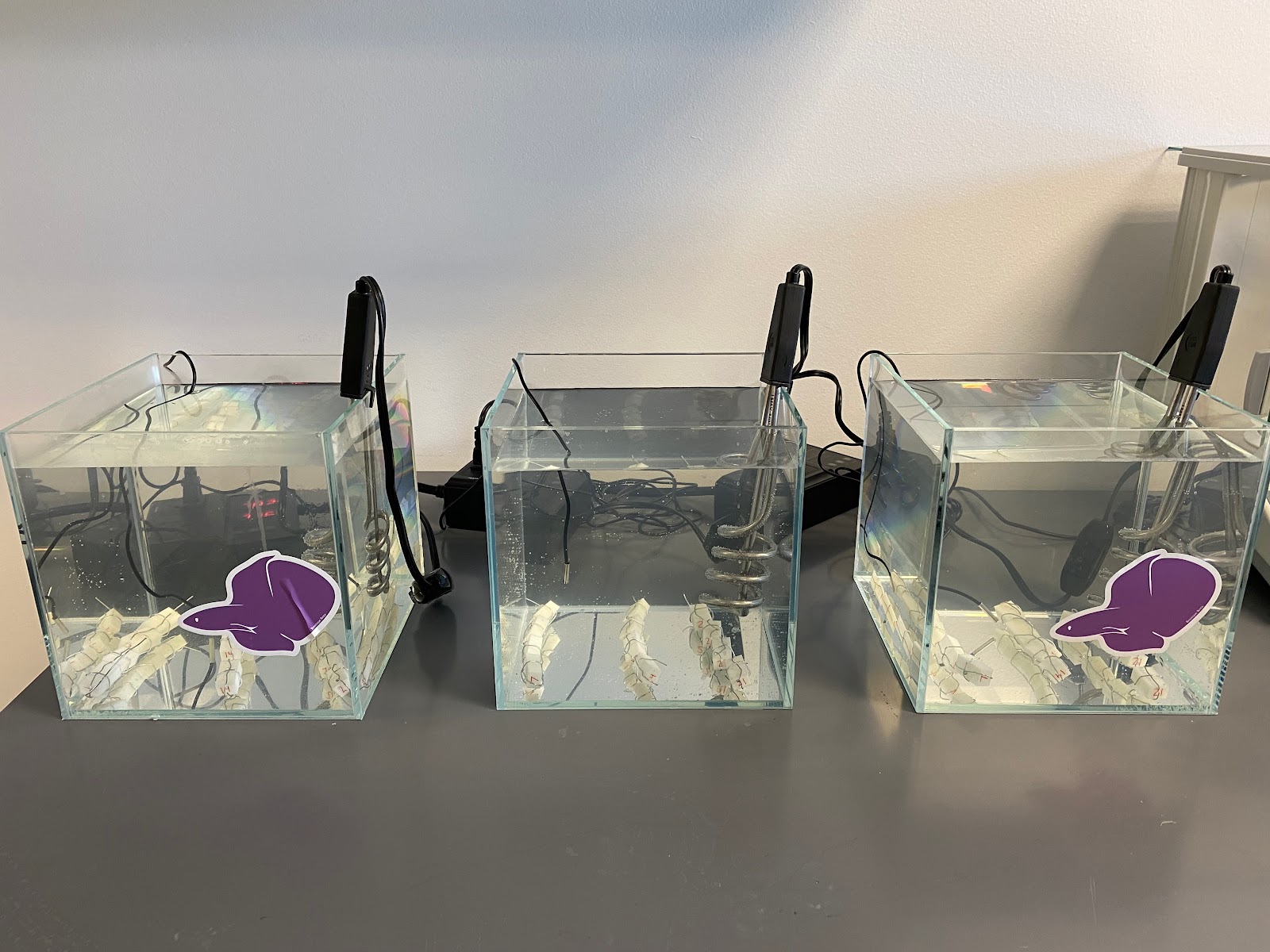
My name is Daniel Hernandez, I am a junior at George Mason University working with Dr. Ali Beheshti to analyze the surface degradation of additively manufactured (AM) ABS polymers for naval application. This project is a continuation of my work done in the summer semester to determine the viability of AM ABS polymers in a saline environment in comparison to their traditionally manufactured counterpart. Where the main focus this semester has been the aging of the ABS samples and observing the changes in the surface topography. The aging chambers consisted of tanks filled with artificial seawater heated to 22°C, 27°C, and 105°C accordingly using a water heater with set submerged durations of 7, 14, and 21 days. My day-to-day interactions consist of ensuring the proper levels of seawater in the tanks and recording the change in mass of the samples. Currently, only half of the samples have been aged though the remainder is set to be finished soon.

The next steps are to assess the surfaces of the samples through micro indentation and profiling tests. These tests will allow for the observation of the change in wear and friction of the surfaces as well as the Young’s Modulus of the samples. Given if time permits mechanical and tribological evaluations will be done on the ABS samples to observe the change in mechanical strength and serve as another method of observing the surface topography of the samples.This has been a rather engaging experience that has allowed me to pursue my interest in the naval engineering field. Furthermore, working with Dr. Beheshti has allowed me to gather a sense of the lab working environment and has compelled me to develop my understanding of the 3D printing process and corrosive behavior of the ocean through whichever future opportunities may be presented.

Sunday, July 3, 2022

URSP Student Tulane Simpson Uses Popular Cartoon to Reimagine Intersection of Environmentalist Theory and Gender Expression


My research involves using popular media as a tool to separate environmentalist practice from the gender binary. Historically, environmentalism has been divided along binary gender lines, as in the cases of ecofeminism and ecomasculinity which use one’s gender as the basis for environmental attitudes. Since environmentalism should be inclusive of all people regardless of gender, I’ve spent this semester developing the environmental theory of ecoandrogyny as an environmental framework that is inclusive of all gender expressions. As popular literature and media are powerful tools or sharing environmental values, especially to young people, I identified Nickelodeon’s Avatar: The Last Airbender as an example ecoandrogynous text for its nuanced depictions of both environmental practice and gender expression.

I have been fortunate to receive an array of support on this project. My URSP funding has allowed me to attend academic conferences where I could meet and learn from other scholars in my field. As I am completing this project in conjunction with Mason’s English Honors thesis course, I received additional assistance with discipline-specific research and drafting issues.

Completing this project will help me reach my future goals of continuing my education and becoming a college-level educator. Not only can my completed paper serve as a writing sample for graduate school applications, I have also gained a strong background in advanced research and writing techniques that will serve me well in my future academic and professional work. Additionally, working with so many outstanding professors, scholars, and library staff has given a better understanding of what I look for in a mentor. This knowledge will help inform my own teaching and mentorship style so that I can serve my future students to the best of my ability.

Sunday, December 19, 2021

Sisc Johnson Created an Adolescent Mentorship in Detention Facilities and Alternative Learning Spaces

For my research project, I created a mentorship program to teach photography and text in alternative learning spaces to court involved youth. Desired outcomes include fostering and promoting positive self-esteem by developing new skill sets acquired from learning the technical and creative skills of photography.  This process also results in promoting positive and respectful communication skills as students learn how to write about and critique their work and the work of others.

This summer I spent three days each week working with 3-5 residents at Stepping Stones. Stepping Stones is a community-based, non-secure residential treatment program for male court involved youth, ages 14-17 that is located in Fairfax County, Virginia.

After our first session each resident was provided with a DSLR camera, two lenses, and a portable flash drive. During our sessions the program participants learned how to operate a DSLR camera. They also learned how to select the appropriate lens and the fundamentals of composition and lighting. Lessons also included instructions on how to upload images from memory cards to Adobe Lightroom and how to edit images in Adobe Photoshop.

The first session of each week would typically begin with a critique of their work from the prior week. The remainder of our time was spent photographing, scrapbooking, creating cyanotypes, and/or learning about other camera-based processes and influential photographers. For the final week of my program, we will have an exhibition showcasing their work to their families.

From my observations throughout the project, I feel that to continue my program in the future a few adjustments could be made in the following ways. For instance, it was difficult having only a single laptop when uploading and editing images with a group of five participants. This was time consuming because I could only work with one participant at a time. Also having an assistant would be beneficial for providing more one-on-one time with each participant. Fortunately, the entire staff at Stepping Stones are vested in the success of each resident, and they were not only very helpful with their ideas and suggestions throughout my program, but I learned a great deal from them regarding how to better handle challenging moments. Because the staff supported me and their residents throughout my entire program, this also added to my awareness regarding what things might be of more interest to the participants.

Measuring the long-term success of my program will not be possible for a few years. As for measuring short term success, I observed drastic improvement not only in their work, but in their behavior. They began dressing up for our sessions becoming more confident behind and in front of the camera. The participant’s critique of their work and the work of others was also impressive and very respectful.

In the future, I plan to continue my work with the adjustments noted above. A few years from now I will reach out to each participant to measure the success of my program.