Friday, October 24, 2014

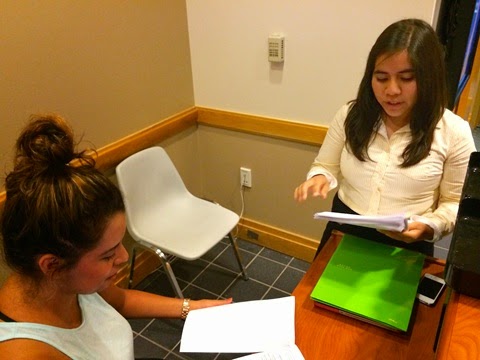
URSP Student Miranda Carver Researches Parent Affiliation and Involvement with D.C. Public Charter Schools


Over the past week, I have traveled to Washington, D.C. on three separate trips; once to attend a PTA meeting for parents of a D.C. public charter school, once to interview one of those parents, and once to observe a school event. On trips like these, I take field notes on moments and interactions that catch my attention. During my metro and bus transit home, I reflect on what this data might reveal about, for instance, negotiations of social roles among school community members, conceptualizations of commonly used or important terms, and logistical aspects of being a part of the school community. These activities are largely what comprise the data collection phase of a case study I am conducting with my research partner Beverly Auman on parent affiliation and involvement with Washington, D.C. public charter schools.

I have been interested in education since before I came to George Mason and began studying anthropology. As I delved deeper into my major coursework, I realized that 1) there is more than one way to study education; and 2) what I want to pursue long-term is applied anthropology, or using anthropological theories and methods to generate solutions to practical problems. My partner Beverly and I recognized our common interest in anthropology and education, and we came into contact with our faculty mentor, Dr. Jenice L. View. Working alongside Dr. View, Beverly and I designed a research study and proposed our project to several different schools. We now work with one school that expressed interest in a research partnership.

This project is essentially an interdisciplinary and mixed-methods study. We are collecting and analyzing both qualitative and quantitative data, using survey, interview, and site observation techniques. Analyzing our data will involve qualitative data coding as well as statistical analyses, and the final products will be a comprehensive research report as well as a presentation of results for the school. Our overarching goal is that many different people – parents, students, faculty, staff, and administrators – will have the opportunity to be included in and benefit from this project.

Thursday, October 23, 2014

URSP Student Andrea Fraser Researches Streambed Microbial Responses to Produced Water from Hydraulic Fracturing Operations


I am incredibly grateful for this opportunity to advance knowledge in environmental infrastructure. I am currently finishing my B.S. in Civil Engineering and will continue with graduate work in Environmental Health Engineering. I hope to work on sustainable infrastructure related projects and conduct research on ways to reduce negative environmental health impacts of infrastructure and civilization.

My current work is on streambed microbial responses to produced water from hydraulic fracturing operations. Large volumes of water are mixed with sand and chemicals before they are injected underground to extract natural gas during the hydraulic fracturing process. The mixture then returns to the surface as produced water that must be treated, managed, and disposed of.  In the event of a produced water spill, understanding microbial responses is important to further explore the potential for bioremediation of this contaminant.

I am fortunate to conduct my study with the Reston Microbiology Lab at U.S. Geological Survey to understand these impacts.  We set up microcosms containing sediments, microbes, stream water, and hydraulic fracturing fluid additives and have been monitoring the microbial responses over time. On a weekly basis I measure the headspace gas on the microcosms to understand if the microbes are operating under oxic or anoxic conditions, as seen in my photo. I also read articles on hydraulic fracturing and produced water to guide my research. We will continue to analyze the data we are collecting on various other biological parameters to understand how these chemicals could affect the crucial microbial communities in sediments. 
I learn something new every day with this project. This week I discovered better ways to use the headspace gas analysis software so that the data is more accurate. 

Wednesday, September 24, 2014

URSP Student Sumin Chung Researches Lacrosse Helmets and Concussions


The project I am currently assisting with is looking at lacrosse players and concussions. Specifically, we are looking at the frequency and magnitude of impacts that high school boys and girls lacrosse players are exposed to in a season. Concussions have long been an inherent risk in the sport of lacrosse, but only recently has it gained national attention with the NFL concussion studies. I gained interest in the study through taking Research Methods with my mentor-to-be Dr. Cortes. Originally, I wanted to start a project geared towards snowboarders and concussion epidemiology, but quickly changed the scope to lacrosse players due to the lack of studies in my original interest. Being a former lacrosse player myself, and also having sustained quite a few concussions in the past through snowboarding and other various sports, I was curious as to what results this study would yield, and with the encouragement of Dr. Cortes, I submitted my proposal for the Undergraduate Research Scholar’s Program.   


This past week, I began the statistical analysis of the girl’s lacrosse player data using SPSS, which is predictive analytics software. The months prior were spent organizing all of the game/practice data into an Excel spreadsheet that was formatted in such a way that importing it into SPSS would be a simple task. Even with a full team of graduate students assisting me, the organizing process was still excruciatingly tedious and long, so the statistical analysis was actually kind of a relaxing moment, despite it being a crucial step in the process. What I have learned from this experience thus far is that nothing ever really goes according to plan; it’s how you decide to roll with the punches that can make or break a research experiment. 

Tuesday, September 23, 2014

URSP Student Brooke Thomas Conducts A Close Examination of the Works of Lucrecia Martel and New Argentine


This summer I was given both the opportunity to study abroad in Buenos Aires, Argentina and complete an undergraduate research project focusing on New Argentine Cinema and the films of the director, Lucrecia Martel. I've been in South America for almost two months now and I am having a hard time believing that both my time here and with this project are almost through! Fortunately, though, I saved the best part of my research for last: a long-weekend trip to the northeast province of Argentina, Salta, where Lucrecia Martel was born. 

This trip was a critical part of my study. Argentina is the eighth largest country in the world; given its size, it is unsurprising that there are many distinct regions and cities within this giant landmass. While I have spent most of my summer in Buenos Aires, a bustling metropolitan that takes its life and architectural style from Europe, I really needed to learn more about Salta and how Martel's hometown affected her filmic direction. Thus, I made the 20-hour bus trip to Salta just last weekend and enjoyed the warmer weather, the gorgeous landscapes, but most of all, the people.

Now that I have spent some time in Salta and can compare it to two other major cities I have visited, Mendoza in the west near Chile, and Buenos Aires in the east, I can see why Martel chooses her birthplace as the set for her films. Not only is Salta aesthetically stunning but the people and culture there are unlike anywhere else in the country. The warmer weather, even in the July winter, the hospitable people, and the slow pace of life make Salta the perfect place to film and the perfect place to reflect on Argentina's distinct regions. Even more, I now understand why Martel often suggests Salta as a peripheral space; while most of Argentina is concerned with globalizing and building infrastructure, the people of Salta are content to move more slowly and enjoy their deep-seeded farming and gaucho lifestyle. Geographically, the city exists well away from the metropolitan epicenter of the country, Buenos Aires, and, more critically, the people also embrace a more conservative, Catholic lifestyle than what can be found in the nation's capital. Getting to experience these physical and philosophical differences between Buenos Aires and Salta is key to understanding Martel's vision and authorial view of class, way of life, and space.

Monday, September 22, 2014

URSP Student Juny Canenguez Researches the Relationship of Cultural Simpatía and Workplace Favoritism

Never would I have though that I would be conducting research on something of that would be of so much interest and significance to me.  With OSCAR funding, I am researching the relationship of cultural simpatía and workplace favoritism. Simpatía is the act of behaving with dignity, respect, courtesy and empathy toward others with the goal of emphasizing positive behaviors and deemphasizing negative behavior. Simpatía is a deeply held value in many Latin American cultures and in this study, my mentor, Dr. Olivia (Mandy) O’Neill and I are investigating whether the cultural value of simpatía is associated with a perception of less favoritism in the workplace.

To test this phenomenon, we created a multi-step survey in English and Spanish to determine whether the language of the survey and personality factors illicit different responses in our subjects. This past week, my main focus has been to find participants, in particular Spanish-speakers, to take survey.  In order for the data to be representative of the population, I have to find as many people as I can to take it. There have been some days of frustration where only two to three people take the survey in a day.  But there are also very rewarding days were 15+ people take the survey. Thus far, gathering data has been the most challenging part of my study, but my findings in the analysis stage should make it all worth it.
I have come to learn it is often difficult to study human subjects.  We all are different in so many ways yet there are some aspects that we share. By doing this study, I now see research like a maze; there are various routes available, but you can only pick one.  However, if the route you choose does not lead to an outcome, it is a matter of turning around and getting on a different route to find something interesting to share. Comes to show that once curiosity enters the mind, not matter how difficult the task may be, a researcher is determined to find an answer.