Monday, September 22, 2014

URSP Student Juny Canenguez Researches the Relationship of Cultural Simpatía and Workplace Favoritism

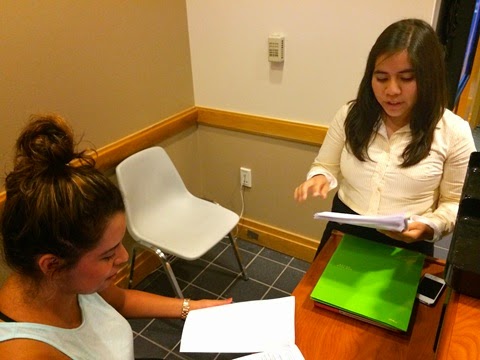
Never would I have though that I would be conducting research on something of that would be of so much interest and significance to me.  With OSCAR funding, I am researching the relationship of cultural simpatía and workplace favoritism. Simpatía is the act of behaving with dignity, respect, courtesy and empathy toward others with the goal of emphasizing positive behaviors and deemphasizing negative behavior. Simpatía is a deeply held value in many Latin American cultures and in this study, my mentor, Dr. Olivia (Mandy) O’Neill and I are investigating whether the cultural value of simpatía is associated with a perception of less favoritism in the workplace.

To test this phenomenon, we created a multi-step survey in English and Spanish to determine whether the language of the survey and personality factors illicit different responses in our subjects. This past week, my main focus has been to find participants, in particular Spanish-speakers, to take survey.  In order for the data to be representative of the population, I have to find as many people as I can to take it. There have been some days of frustration where only two to three people take the survey in a day.  But there are also very rewarding days were 15+ people take the survey. Thus far, gathering data has been the most challenging part of my study, but my findings in the analysis stage should make it all worth it.
I have come to learn it is often difficult to study human subjects.  We all are different in so many ways yet there are some aspects that we share. By doing this study, I now see research like a maze; there are various routes available, but you can only pick one.  However, if the route you choose does not lead to an outcome, it is a matter of turning around and getting on a different route to find something interesting to share. Comes to show that once curiosity enters the mind, not matter how difficult the task may be, a researcher is determined to find an answer.  

Friday, September 19, 2014

URSP Student Julia Bourguignon Researches the Effect of Spices on Calcium Influx and CGRP Levels and their Relation to Migraine

This week was a hectic one! With our URSP celebration and research presentation around the corner, some serious data collection was in order. With my project, I am investigating the effects of two spices, ginger and turmeric, on potential mechanisms of migraine.

This week I conducted a CGRP secretion assay. It is believed that calcitonin gene-relation peptide (CGRP) secretion is correlated with sensitivity and inflammation. We are looking at whether treatment with ginger or turmeric will affect secretion levels in CA-77 cells. This is done through a rat enzyme immunoassay (EIA) kit, where we hope to see changes in CGRP secretion among the different treatments we apply to each column of cells. To perform the kit, three days are required, where I will plate cells onto a 96-well plate, treat them with varying concentrations of the spices, and then stimulate CGRP secretion with potassium chloride. From there, I can collect the secretions, dilute them, transfer them to another plate and apply a tracer which will help to detect the varying levels of CGRP after the addition of Ellman’s reagent. Finally, I take a plate reading to quantify the results, and perform statistical analysis to view significant differences among treatments. 


Next week we will look into a Calcium Imaging study, which helps us to detect if these spices will have an effect on calcium channel inhibition in PC-12 cells. More information to come on that study!

Thursday, September 18, 2014

URSP Student Orsolya Buzas Researches Hungarian Politics and Democratic Transition

I have attached a picture of me while I was in Hungary for the Spring semester where I did a portion of my research. Hungarian politics and democratic transition is also the focus of my research. In the background the Parliament is visible as well as the Danube and the castle on the opposite side of the river.

Upon finishing a book this week, recommended by my mentor, I felt as if the direction of my research has been illuminated. Why Nations Fail, a piece on theories that explain the existence of successful and failed states allowed me to place the post-Soviet Central and Eastern European countries I have been observing into perspective according to the theories. I was now able to go beyond international ratings of economic freedom and rule of law such as Freedom House's Freedom in the World Ranking. Interpreting the institutional differences between these states and the way they developed over the centuries allowed me to explain their reactions to democratic transition and their current political state. By discussing the presentation of my project and the physical poster, I had to visualize the clear elements of my research that during the past months I have overlooked and instead, followed a path of recommended studies and current talks. By refining and simplifying my project to Background, Hypothesis, Process, and Solution I was able to eliminate branches of my research and separate those thoughts for further analysis in the future. Perhaps another topic for new research possibilities.

Wednesday, September 17, 2014

URSP Student Samantha Wilkins Explores The Effect of Dietary Copper and Zinc on Fear Extinction


My study is exploring the behavioral effects of varying levels of dietary copper and zinc in rats, specifically looking at learning and memory through fear extinction, and motor coordination through accelerating rotarod paradigms.  We have five dietary conditions, three of which serve as different controls, and two of which induce a copper deficient state.  The rats must be reared on their respective dietary conditions from birth until four months of age before they undergo behavioral testing.  

At the present stage of the project, we have a pilot group of rats that are being raised on their diets and are due to begin behavioral testing in early September.  In the meantime, regular tasks include checking on the rats daily to ensure their well-being, and handling them twice a week so that they become acclimated to researcher interaction.  Also, importantly, we must refill the food containers and monitor their dietary intake through food weights.  Since adolescence has been reached, this process is typically done twice a week to keep up with the rats’ growing appetites.  Additional work throughout the week also involves preparation for the behavioral measures, which must be thoroughly planned to ensure that any potential errors, interference, or confounds can be eliminated before the testing begins.  During this past week, we have been trying to determine which parts of the lab should be utilized as the environment for the fear conditioning and subsequent fear extinction days of testing, to avoid contextual interference and erroneously high freezing rates in the rats during fear extinction.

Tuesday, September 16, 2014

URSP Student Mihret Tafesse Analyzes the Contribution of Microtubules to Cell Structure and Function

My research project focuses on analyzing the contribution of microtubules to cell structure and function.  This week I worked with cells that I have transfected with EGFP tubulin to allow the microtubules to show green fluorescence.  I used a micro patterning method to allow cells to bind to treated patterns on a petri dish.  This way, I can analyze the microtubules and the  correlation of microtubules and cell structure. In these micro patterns, generally 1 to a few cells generally fit in each pattern.  The shapes of these cells is then analyzed after they attach to these specific patterns.   To make this experiment happen this week, I also had to do work preparing the cells, petri dishes and other equipment used.