
Monday, September 15, 2014
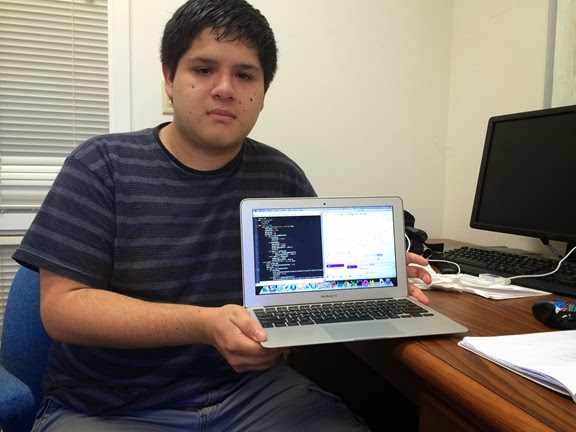
URSP Student Joseph Frias Researches How Group Halo Mass Affects the Properties of the Intergalactic Medium
My work deals with certain astronomical objects called
galaxy groups. These are collections of galaxies like our Milky Way that are
gravitationally bounded to each other. It’s kind of like those coin wells that
are in some shopping malls. In between the constituent galaxies (they are like
the coins going around the center), there is hot gas (We call it the
Intergalactic Medium, or IGM for short), mostly made up of Hydrogen. It is this
gas we are interested in, as it can contain a lot of clues as to how the galaxy
group, and also its constituent galaxies, changes over time.
My work so
far has been primarily collecting data on the IGM in certain groups using my
programming skills. This week started off similarly. We had some preliminary
results, but before we started interpreting them we needed to make sure our
data sample was based only on gas in the IGM. As a galaxy group has constituent
galaxies, the galaxies themselves have lots of gas inside them, and this may
not reflect the overall IGM characteristics. So, we took some time to cross
check the objects we were measuring with a galaxy catalog based on the groups
we were studying. For this I created a program to match specific groups with
their constituent galaxies. With this information collected, we are currently
using Astronomical programs like TOPCAT to determine how many of our data
points are actually associated with the group environment itself.


Friday, September 12, 2014
URSP Student Liana Glew Researches Temporal Multiplicity in Stagnant Realities

Saturday,
July 19th: The day began with a flood of nerves. After waking up long
before the alarm, I sought out breakfast on the unfamiliar campus,
intending to rehearse my paper and escape the Mississippi heat over iced
coffee. Afterwards, I arrived at the conference center quite early, where my
fellow panelists chatted and rehearsed their own papers. For many of us, this
was our first time presenting our work at a conference -- the Southern Writers,
Southern Writing graduate conference proved a welcoming and inviting
introduction to the world of academic conferences. The presentations
all went smoothly and spurred stimulating questions and discussions.
Sunday,
July 20-Wednesday, July 23: The following conference, Faulkner and
Yoknapatawpha, kicked off with a catfish dinner on Faulkner's own lawn. The
three days involved copious amounts of caffeine, hours of gripping
presentations, evenings of sightseeing in town, and discussions over
dinner about research and dissertations.
Thursday,
July 24-Saturday, July 26: I returned home with new ideas and motivation for my
URSP project. I finished sifting through my notes in Joyce's Ulysses,
completing a document of passages, sorted by country, that show the
international influences upon the novel's Dublin. By Saturday, I began the same
process for Faulkner's Sound and the Fury. Both the upcoming process of
mapping these findings and the vastly international attendance at the Faulkner
conference have started to prove my initial hunch that Joyce's Dublin
and Faulkner's Mississippi are not nearly as provincial as they may seem.
Thursday, September 11, 2014
URSP Student Herath Pilapitiya Understands Alzheimer’s by Modeling beta-amyloids that Bind to GPCRs

The main
objective of the project is to model in detail the process of how beta amyloids
can bind G-protein coupled receptors (GPCRs) and to do so in silico. Detailed
modeling of protein-ligand binding is traditionally conducted via Molecular
Dynamics (MD) simulations. Simulating MD simulations in silico is expensive and
not feasible, practically. Our approach is not based on running expensive MD
simulations but is just as accurate and reliable. The approach relies on dense
sampling of the ligand conformer space.
The first 1-2
weeks in my research I read many journal articles to understand the interaction
between beta amyloids and Nicotinic Receptors, and to find out what are other
protein docking software used in the field. Throughout the research I used a
molecular modeling software called PyRosetta, a Python-based interface to the
Rosetta molecular modeling software. It allows users to create custom docking
algorithms using Python scripting. This week I ran several docking simulations to
reveal possible differences between the native and aggregation-prone (diseased)
form of the amyloid-beta peptide when binding to alpha-7 Nicotinic
Acetylcholine Receptor (a7 nAchR). Once I get all docking simulation results I
am going to analyze total energies and corresponding binding poses using a
linear dimensionality reduction technique known as Principal Component Analysis
(PCA).
During the
whole process, the guidance from my mentor was great. The experiences that I
gained while working on my research project helped me to improve my research
skills and will help me to be a successful researcher in the future. The USRP
program is a great opportunity for undergraduates at Mason to enhance their
research skills.
Wednesday, September 10, 2014
URSP Student Kayla Story Works in the Field

Contrast
is an element of anthropology that I have confronted only recently. My
research began with work "in the field;" approaching strangers,
establishing connections, and conducting interviews across small tables. I was
armed with a voice recorder, note pad, pen, and the occasional cup of coffee.
This "field work" came to its inevitable end, bringing me to an
entirely different, isolated space, where social interaction was replaced by
the constant pattering of my fingers across computer keys.
As
I drum along in my endless Microsoft Word document, I am faced with the
challenge of transforming each interview, each sample of complex subcultures,
into semi-quantifiable, interpretable data. Individuals cannot really be
reduced to scientific data, which means my true task is to discover what can be
learned from these individuals, and allow the lesson to take the form of data.
A careful, considerate narrative will be key. This week, I am working on that
key. This week, my Word document becomes even longer.
My
work will conclude with another reminder of anthropology's contrasting nature,
as I present my results – the careful narrative – to people. The research will
finish as it started, taking the form of a social process. For this week, the
tapping of these keys is sufficient company.
Tuesday, September 9, 2014
URSP Student Georgia Wood Researches the Influence of Dante on Morrison

On
a weekly basis, I work with either primary or secondary texts in order to
strengthen my argument by seeing where others have been previously. As I am
creating a literature review, I find both the strengths and the weaknesses in
the articles to find where research is lacking in the current critical
conversation. In addition, I have been working with the texts to find my own
connections between the works. This week, I have begun to add these personal
assertions to the established criticism. For example, the two intermediate
works, Dante’s Purgatorio and Morrison’s Jazz, include images of
birds. Dante dreams of an eagle that lifts him, and Morrison draws on that
image within her novel to showcase the range of potential for her characters’
mobility, physically and otherwise. As I
hope to continue my studies in graduate school, this project has provided me
the valuable opportunity to learn the research process under the guidance of a
supportive mentor. At the beginning of this project, I struggled with how I
could say anything that had not been said before. I’ve learned now the
importance of research to the academic world, and how discovering information
that has not been said only opens the door to more.
Subscribe to:
Posts (Atom)